
Scoliosis largely affects the spine and its immediate surroundings, but it may also cause widespread effects, especially for patients with larger progressive curves, or if left untreated. The most common direct effects of scoliosis are usually postural changes, muscle imbalances and weakness, and pain (adult scoliosis), but the brain can be indirectly affected by these changes.
Scoliosis doesn't directly damage brain tissue, but it can affect the flow of cerebrospinal fluid in and around the brain, balance control and posture which the brain is involved in, and mental health. Because the brain and spinal cord make up the central nervous system, scoliosis can also affect nerve health and function.
For patients concerned about increasing symptoms, a proactive treatment plan may minimize the impact of scoliosis on the brain and body, and guidance from a CLEAR scoliosis clinician can clarify the different treatment options.
The main effects of scoliosis usually include postural changes in children and pain in adults, and while scoliosis doesn't directly affect brain tissue, it may indirectly affect brain health through changing the flow of cerebrospinal fluid (CSF) in and around the brain and spinal cord.
Because scoliosis causes the spine to curve and rotate unnaturally, it may affect the flow and levels of cerebrospinal fluid in and around the brain, and there are also studies that support a connection between idiopathic scoliosis causation and pre-existing CSF irregularities (1).
The brain and spine make up the central nervous system, and cerebrospinal fluid keeps the nervous system functioning and healthy.
The central nervous system is the body's vast communication network that connects the brain and body, so affecting the nervous system can indirectly affect the brain.
Cerebrospinal fluid provides cushioning around the brain and spinal cord to prevent damage in the event of an accident or impact, and the buoyancy factor allows the brain to float. Think of how an enclosed container of water would protect an egg encased within if the container was bumped or dropped.
The spinal cord contains 31 pairs of spinal nerves that branch off to different areas of the body supporting a number of voluntary and involuntary responses, so cerebrospinal fluid also provides cushioning around the spinal cord within the spine.
Cerebrospinal fluid has water-like consistency but is nutrient-rich and carries necessary glucose and proteins to nourish the brain, and it also carries waste products away from brain tissue, keeping it clean and healthy.
Cerebrospinal fluid also regulates the temperature and pressure levels inside the head and is made daily by specialized brain cells in the ventricles. If fluid levels are low around the brain because the spine's unnatural position is interrupting its flow below, patients may develop headaches that, in some cases, turn into migraines.
 The risk of scoliosis affecting cerebrospinal fluid levels increases with progression, but with a proactive treatment plan that supports the spine's straight alignment for clear flow between the brain and spine, issues with CSF may be preventable.
The spine serves a lot of key functions in overall health, one of which is to support healthy posture, balance, and movement patterns.
Because the spine acts as the body's central structural anchor, it gives us balance and stability, but if the spine shifts its alignment and becomes off balance, the entire body can become misaligned, and the earliest changes caused by scoliosis, in most cases, involve a loss of postural control, balance disruptions, and back, muscle, and/or nerve pain in adults.
A straight and upright spine is supported by a straight and aligned torso, so healthy posture supports the spine's balance and position, and an aligned spine supports the torso's alignment.
The spine also acts as an attachment point for a number of muscles and supportive structures, and if the spine curves and twists unnaturally, it can contribute to muscular imbalance and weakness due to strain and uneven forces.
A lot of factors contribute to maintaining healthy posture, and the brain plays a major role by constantly processing sensory input and feedback from the body that supports even posture, balance control, gait, and proprioception; conversely, poor postural control can affect the brain by disrupting the ability of the spine to send accurate sensory information to the brain, and it may also contribute to reduced blood flow and CSF irregularities (2).
Pain is more often a part of the adult scoliosis experience, and pain can also affect posture and the brain. When stress and pain are occurring, the brain can send the message that a protective slouching posture may help, and if the postural deviation is left unaddressed, over time, it can essentially reprogram the nervous system to support the body's new position, which is unhealthy for the brain, the spine, and mobility.
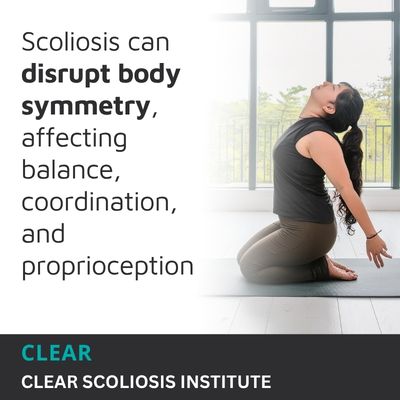 Balance is based on symmetry, and as an asymmetrical condition capable of disrupting the body's overall symmetry and alignment, scoliosis can cause a loss of balance, coordination, and proprioception, and the brain is involved in all of these functions.
The more healthy posture is disrupted, the more noticeably gait and coordination may be affected, and uneven posture and movement patterns can contribute to a lack of spinal support and the onset/progression of some scoliosis curves.
Ultimately, if the spine is misaligned, it's causing uneven forces that can affect the entire body, including the brain, and the scoliosis is also affected further by the uneven forces of poor posture and weak and/or unbalanced muscles increasing due to progression.
Scoliosis can disrupt reliable sensory input and feedback between the brain and spinal cord, and the rest of the body, in some patients, and because the brain is also involved in mood regulation, the psychosocial effects of scoliosis may impact mental health.
Most patients with scoliosis can lead normal healthy lives, particularly those who are proactively treating the curve, but due to the body appearance changes it can cause in children and adolescents, some scoliosis patients may experience mental health issues and need support and understanding (3).
A diagnosis of scoliosis can be stressful for any patient, regardless of age, but due to the postural changes, and changes to gait, that childhood scoliosis can cause, teens may be at a high risk for body image and self-esteem issues.
Also, in some cases, a child may receive a full-time bracing recommendation which can include wearing the orthotic device at school. A lot of adolescents don't want to stand out from their classmates and peers, and for those experiencing changes to gait, balance, and coordination, further disruptions can trigger a stress response, and stress affects brain health and emotional regulation.
Brain regions most affected by scoliosis include the amygdala, hippocampus, and the prefrontal cortex because they are involved in processing emotions and fight or flight responses, learning, memory, decision making, and emotional control.
If scoliosis is causing significant prolonged stress, it can trigger the steady flow of cortisol, and the stress hormone can affect the brain's structure, function, and chemistry over time (4), and this is all the more reason to treat scoliosis proactively: to preserve a patient's long-term mental health and quality of life.
Primary scoliosis effects involve posture, movement, muscles, and pain, but because the brain and spine work in tandem as the central nervous system, the brain and spine are involved in many bodily functions and systems.
If the spine is curved and rotates unnaturally, it may affect the brain through disrupting the flow of cerebrospinal fluid to and around the brain, accurate sensory input due to poor posture and a loss of balance control, and changing mental health due to stress.
There are so many variables that shape a patient's scoliosis symptoms including progression and curve severity, but in many cases, early detection and timely treatment support proactive curve management for minimizing symptoms and the risk of complications.
Here at the CLEAR Scoliosis Institute, a patient's curve is comprehensively assessed so clinicians fully understand a patient's situation, including the types of symptoms they may experience, and can make informed treatment recommendations.
CLEAR provides a unique and innovative way of understanding scoliosis. Sign up to receive facts and information you won’t find anywhere else.