

Scoliosis describes an unnatural sideways spinal curve with rotation that affects the spine, the spine's surrounding muscles, and the entire body in some cases. The spine relies on its surrounding muscles for support and stability, but the uneven forces introduced by the spine's unnatural curve and twist can cause a muscular imbalance and strain back muscles.
What scoliosis patients should know about massage therapy is that it needs to be scoliosis-specific and performed by someone with scoliosis-specific training. While it's not a treatment for scoliosis, for some patients, it may offer symptom relief and increase treatment responsiveness.
Massage therapy may benefit some scoliosis patients through symptom relief, but it can't address the underlying structural nature of scoliosis curves.
Massage therapy can't increase muscle tissue, but it can relax sore muscle tissue and contribute to muscle flexibility and range of motion for pain relief.
Scoliosis curves can vary in size and cause a range of effects. In children, the main symptoms of scoliosis involve postural changes, and in adults, it's back pain, muscle weakness, and nerve pain.
Back pain is a common cause of disability in adults, and while children can also experience scoliosis pain, it's less likely because the spine is still growing, and growth allows for a certain degree of curve flexibility that counteracts the curve's compressive effect.
Curve flexibility is also an important factor for treatment responsiveness and the spine's surrounding musculature plays a role in how much support and stability the spine gets from its surrounding muscles and supportive structures.
Many people turn to massage therapy for relief from sore and strained muscles, muscle spasms, and general back pain, and scoliosis pain can come from the curve itself, muscles, joints, and nerves.
It's important for scoliosis patients to understand, however, that symptom relief is not the same as treating the scoliosis for long-term improvement.
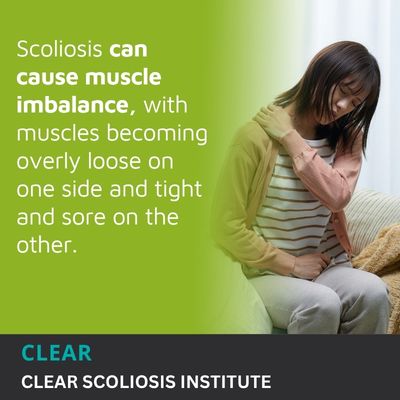 A common effect of scoliosis in patients of all ages is muscular imbalance caused by the muscles that support the spine being pulled in opposing directions. Typically, muscles on the inside of the curve may be extra loose and flexible, and muscles on the outside of the curve are usually tight and sore.
Overworked muscles can spasm and cause pain, and may contribute to curve onset and/or progression in some patients.
Deep tissue massage, when it's specialized and targeted, can focus on easing sore and tight muscles while stimulating circulation around weak and slack muscles to reduce muscle tension and pain.
In certain instances where a patient can benefit from deep tissue penetration, specialized massage tools that use pressure and vibration to stimulate muscles and improve circulation can be used. Although massage therapy on its own can't correct a curve, when it's combined with treatment that has corrective potential such as scoliosis-specific chiropractic care, exercise, and 3D bracing when appropriate, it can help by preparing muscles for treatment.
When tight muscles on the outside of the curve are targeted prior to a treatment session, it may help mitigate the effects of a muscular imbalance further contributing to the spine's lack of support and misalignment.
Scoliosis massage therapy can alleviate pain and discomfort for some patients by relieving muscle tightness for improvement to muscle flexibility and range of motion.
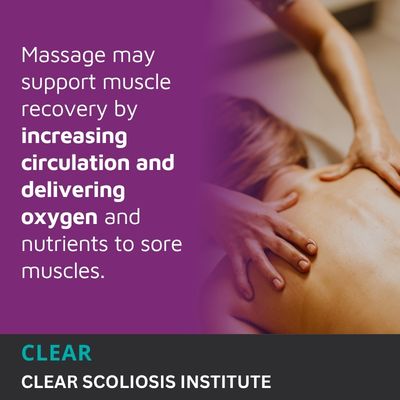 Massage may also offer overall improvement to muscle health through increasing circulation. Applying mechanical pressure to increase local circulation around a sore muscle helps transport oxygen and nutrients needed for muscle recovery and to eliminate waste.
Improving circulation around the spine can also improve spinal disc health for overall improvement to spinal health and function. Discs sit between the spine's vertebrae and provide structural support, shock absorption, flexibility, and cushioning, and poor disc health can contribute to scoliosis onset or progression in some cases. Discs don't have their own vascular supply, so increasing circulation around a degenerating disc may preserve disc function and slow further deterioration.
Regular massage therapy may exacerbate symptoms of scoliosis if muscles that are overworked and in need of relaxation are irritated and muscles that are underworked are left alone.
A scoliosis massage therapist will understand the nature of scoliosis curves and how they affect their surrounding muscles. They will recognize when muscle stimulation is beneficial and when the goal is to relax muscle tissue.
While increasing circulation through massaging deep spinal musculature may relieve discomfort, muscle stiffness and muscle cramps in some patients, it's more about temporary relief than long-term improvement.
By integrating massage therapy into a proactive care plan with corrective potential, however, it may help relieve symptoms and increase treatment responsiveness.
Here at the CLEAR Scoliosis Institute, our approach is to blend scoliosis-specific treatments with a number of therapies for complete customization.
When combined with scoliosis-specific exercise and chiropractic care, massage may help prepare the spine and muscles for exercise-based treatment or manual chiropractic adjustments by supporting flexibility and relieving pain so patients are better able to perform key therapeutic exercises.
Loose flexible muscles around the spine support healthy movement and a wide range of motion and pain-free function. Flexible back muscles support strenuous movement such as bends, lifts, and twists without muscle strain and injury.
When muscles are loose, they don't tighten around the spine, feed its misalignment, and expose the spinal discs to uneven pressure and wear that may accelerate the degenerative process, and stretching muscle tissue increases blood flow that helps with muscle repair, recovery, and disc health.
Flexible muscles also support healthy posture, and the health of the spine affects a person's posture, and posture, in turn, over time, can affect spinal health and function.
Flexible muscles work with the spine for dynamic stability, range of motion, and supporting the spine's facet joints during movement.
Healthy back muscles also help absorb weight force and stress to prevent strain on spinal discs and facet joints.
So for patients whose massage therapy is relieving back and muscle pain, they may be better able to perform scoliosis-specific exercise as a primary nonsurgical scoliosis treatment option, and if deep tissue massage is specialized for scoliosis and considers which muscles can benefit from loosening and which need stimulation, the spine's healthy position can be further supported by flexible muscles that don't tighten around the spine, moving with it and supporting it instead.
A strong flexible spine with a wide range of motion that's surrounded by flexible supportive muscles may be more responsive to scoliosis-specific chiropractic adjustments that work towards addressing the structural nature of scoliosis curves.
Although massage therapy can't treat scoliosis and impact the structural nature of the curve, it may provide some therapeutic benefits that enhance scoliosis-specific treatment efficacy and pain relief for a better quality of life.
There are a lot of factors that influence a patient's spinal health and scoliosis curves. The brain, core and back muscles, supportive structures, discs, facet joints, and body posture all work together to maintain the spine's straight alignment, function, and overall health.
When scoliosis develops and/or progresses, it's exposing the spine and its surrounding muscles to uneven pressure that, over time, can cause uneven wear and strain that feeds a scoliosis curve and degenerative changes to spinal health over time.
Specialized scoliosis massage therapy can relax sore and stiff muscles that are overworked and stimulate muscle tissue for better blood flow. For some patients, it can support the spine's flexibility and healthy range of motion for mobility and postural improvement.
Patients do need to understand, however, that massage therapy is considered an adjunctive treatment and can't replace evidence-based scoliosis-specific chiropractic care and targeted corrective exercise plans that are at the center of nonsurgical scoliosis management.
For scoliosis patients in need of pain relief, a personalized assessment from a CLEAR-certified scoliosis chiropractor considers whether massage therapy is suitable for a particular scoliosis curve.
CLEAR provides a unique and innovative way of understanding scoliosis. Sign up to receive facts and information you won’t find anywhere else.