

What you need to know about scoliosis is that, in many cases, its impact can be minimized with a proactive treatment plan. As a progressive condition, mild curves can become severe, and increasing effects may include digestive issues.
Some scoliosis patients may experience digestive problems such as constipation, bloating, acid reflux, stomach pain, and irritable bowel syndrome. Digestive problems are more common with large curves that can compress digestive organs, interfere with nerve communication, and reduce spinal motility.
A scoliosis assessment considers a patient's risk of curve progression and suitable treatment options.
Digestive Problems and Scoliosis
Large scoliosis curves are more disruptive to overall health than small curves, in most cases, and if scoliosis isn't diagnosed, is left untreated, or is progressing quickly during treatment, digestive problems may develop.
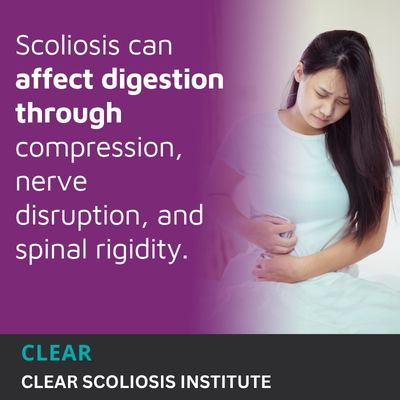 Scoliosis can affect the digestive system by causing compression, nervous system interruption, and spinal rigidity.
What you need to know about scoliosis and the digestive system is that addressing a curve may minimize its impact and, in some cases, prevent the development of digestive system issues, and/or improve issues that are occurring.
Not all scoliosis patients will experience digestive issues. They are more common in adults because once growth stops, scoliosis becomes compressive.
When growth stops and skeletal maturity is reached, the compressive force of the spine's unnatural curve and rotation increases, and uneven and excessive pressure on the spine, its individual structures, and the spine's surroundings can cause a number of effects.
The digestive system's primary function is to break down food into nutrients needed by the body for energy, growth, and cellular repair. Patients experiencing digestive issues are likely to feel tired, may not be getting the nutrients needed for growth and immune system health, and may be slow to recover from injury.
There are a number of organs involved in digestion including the stomach, intestines, gallbladder, and pancreas, and an abnormal spinal curvature can shorten the torso and squeeze the abdominal cavity and digestive organs within.
This loss of space within the abdominal cavity can impair digestive-organ function and slow food as it moves through the digestive tract.
A role of the spine is to protect the spinal cord and its 31 pairs of spinal nerves that work with the brain to form the central nervous system (CNS). The central nervous system facilitates communication between the brain and the rest of the body so is involved in how the body's many systems interact and function.
The central nervous system helps regulate the gastrointestinal tract, and if a large curve is compressing nerves of the spinal cord, or nerve roots where they exit the spine, nerve signals from the brain to digestive organs may be interrupted.
An interruption in brain-digestive organ communication can also slow the digestive tract.
A healthy spine is strong and durable, but also flexible to support movement, and an effect of scoliosis is spinal rigidity. If a small curve is left untreated and progresses into a larger curve, an effect is increasing spinal rigidity.
Curve flexibility is a factor that can affect treatment planning and outcome, so another benefit of early detection is starting treatment while curves are small, they're more flexible, and may be more responsive.
If the spine becomes rigid, its lack of motility doesn't just affect the spine, but also its surroundings, and because a scoliotic spine also twists and may become more so over time, nearby organs and tissues may lose their flexibility causing digestion to slow down and become sluggish.
Scoliosis patients who understand their curve, the factors that may be affecting them, and effects of progression are more likely to notice changes that need to be assessed and factored into treatment planning.
A scoliosis curve can be affected by a number of factors that can change, so close monitoring is important to watch for signs that a curve is increasing and treatment needs to be adjusted.
If a curve is progressing, it's getting larger, and the uneven forces of the curve are increasing. Increasing effects is a sign of curve progression.
Signs that scoliosis is affecting the digestive system include stomach pain, bloating, constipation, acid reflux, heartburn, slower bowel movements, nausea, feeling full after small amounts of food, and poor nutrient absorption.
Weight loss can indicate a patient isn't consuming enough food, and over time, this can further disrupt a patient's overall health. Blood work can check a patient's level of nutrients, minerals, and essential vitamins and looks for deficiencies caused by digestive issues.
While digestive problems aren't considered a common effect of mild scoliosis curves, large curves may cause widespread effects. Common effects of scoliosis include uneven posture, muscle weakness, and pain.
Knowing the early signs of scoliosis can help diagnose curves while they're still small and may be more responsive to conservative treatment, and in some cases, proactive management can preserve digestive system function and health.
In children, the earliest signs of scoliosis are usually postural changes such as uneven shoulders, uneven shoulder blades, uneven hips, and one side of the rib cage protruding excessively (rib cage hump).
In adults, postural changes and pain are common effects. Adults tend to experience different effects due to skeletal maturity. As mentioned, scoliosis can be progressive, and growth is the main trigger for progression in children, and declining spinal health in older adults can also cause scoliosis to change quickly.
 Understanding the many factors that drive curve progression and increasing effects are important, and a scoliosis assessment considers a patient's progression risk factors for personalized care recommendations.
Patients with severe scoliosis are the most likely to experience severe effects including digestive problems, so the goal of proactive management is preventing progression and increasing effects. Small curves cause fewer effects so keeping a small curve mild is the goal of a proactive treatment approach.
In some cases, a timely assessment and proactive scoliosis treatment plan can prevent digestive symptoms from developing.
There is an important distinction between addressing the symptoms of scoliosis, or their underlying cause, the scoliosis itself.
When it comes to digestive-system health, managing curve progression is key because digestive problems are most closely associated with larger rigid curves, but in some cases, a proactive care plan supports curve management for less impact on the body's systems.
Addressing the spine's misalignment means improving its position so it's held in a straight and neutral alignment, compression is reduced, pressure on nearby nerves is relieved, spinal flexibility is improved, and healthy posture is supported.
Here at the CLEAR Scoliosis Institute, treatment recommendations are personalized but can include close monitoring, scoliosis-specific exercise plans, scoliosis-specific chiropractic care, and when suitable, corrective bracing.
Conservative treatment is integrative; it relies on a number of treatment modalities and how they work together to impact the spine, its surroundings, and the overall body for optimal digestive system function and health.
What you need to know about scoliosis is that mild curves can change quickly if progression is occurring, and large curves can cause digestive system issues in some cases. Bloating, stomach pain, heartburn, acid reflux, and constipation are signs that scoliosis may be affecting the digestive system.
Due to the spine's unnatural curve and rotation, it can compress the abdominal cavity and digestive organs within, interrupt nerve communication between the brain and digestive organs, and cause a loss of motility in and around the spine.
There are a number of factors that shape a curve's stability or progression, and a specialist evaluation provides patients with guidance on the type of symptoms they may experience, their risk of curve progression, and recommends suitable treatment options.
Every patient responds to scoliosis and treatment in their own way, but in many cases, early detection and intervention supports proactive curve management to minimize the condition's potential effects, including digestive problems.
CLEAR provides a unique and innovative way of understanding scoliosis. Sign up to receive facts and information you won’t find anywhere else.