

People most often need wheelchairs due to severe muscular conditions, paralysis, stability issues, injury, and fatigue. While scoliosis can cause fatigue, muscular issues, and instability, paralysis isn't an effect of scoliosis, and disruptions to mobility can be managed with treatment in most cases.
For the vast majority of patients, scoliosis won't put them in a wheelchair. While changes to gait and mobility can occur, mild and moderate, and even severe curves, can be highly treatable. Neuromuscular scoliosis patients are most likely to need a wheelchair, but these cases are atypical, and severe effects are more related to the larger neuromuscular condition than the scoliosis.
Common effects of scoliosis include postural changes, muscle weakness, and pain, but in typical cases, these changes don't require a wheelchair.
The effects of scoliosis can be widespread. The spine's unnatural lateral curve and rotation can cause postural changes, muscle weakness and imbalance, pain, and disruptions to balance, coordination, and gait, but rarely to the level of needing a wheelchair in typical cases.
As an asymmetrical spinal condition, scoliosis can disrupt the body's overall symmetry and balance; however, scoliosis ranges widely in severity, and the changes can range from mild and subtle to moderate or severe and disruptive.
However, scoliosis can be progressive, particularly when growth or declining spinal health are occurring, so diagnosing and treating scoliosis early can minimize its impact for many patients.
It's not always easy to diagnose scoliosis because many curves are small and don't cause noticeable effects.
In many cases, patients aren't diagnosed until their curve has progressed and the effects are more overt. 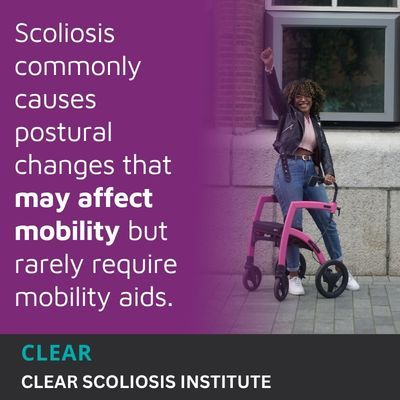 Postural changes are the most common visual symptom of scoliosis, and while they can contribute to mobility changes, they don’t usually lead to reliance on mobility aids.
Postural Changes
Common postural changes caused by scoliosis include uneven shoulders, uneven hips, an arch in the rib cage, and a prominent lean forward or to the side. While postural changes can cause a lot of issues, including uneven wear and unhealthy movement patterns, a wheelchair doesn't correct poor posture or address the cause.
In typical cases of scoliosis, changes to gait and mobility may be challenging, but rarely lead to the need for a wheelchair, particularly with the help of a customized care plan working to restore healthy posture and movement patterns.
Postural changes are the earliest signs of scoliosis in children, but even overt postural changes aren't commonly associated with wheelchair use.
As mentioned, severe muscle weakness is a common reason for wheelchair use, and a primary effect of scoliosis is weak and unbalanced muscles, but most cases of scoliosis involve mild and moderate curves, and muscle effects can be effectively managed, in many cases, with scoliosis-specific physical therapy and targeted exercise.
Scoliosis can affect muscles by exposing them to uneven forces, and this can cause a muscular imbalance. If muscles on one side of the spine have to work harder to counteract the spine's unnatural curve and rotation, while muscles on the opposite side become weak from lack of use, an imbalance can develop, and proper alignment of the spine and body need proper support.
Weak, sore, and unbalanced muscles can be painful and disruptive, but a focus of scoliosis treatment is muscle strengthening and balancing for uniform spinal support, and customized scoliosis-specific exercise plans support improvement to muscle strength and endurance.
Now, in severe and/or atypical cases of scoliosis, symptoms may be harder to manage, and as mentioned, there is an atypical type of scoliosis that makes some patients more vulnerable to extreme muscular changes: neuromuscular scoliosis.
Of the main types of scoliosis, including idiopathic and degenerative scoliosis, neuromuscular scoliosis is the most closely associated with wheelchair use.
Neuromuscular scoliosis cases can be very severe because the scoliosis is caused by a larger neuromuscular or muscular condition such as cerebral palsy, muscular dystrophy, spina bifida, or spinal muscular atrophy.
In these cases, the larger neuromuscular disease causes an interruption in the connection between the brain, the spine's surrounding muscles, and connective tissues, and this disrupts spinal support and stability. Spinal muscular atrophy causes the breakdown of nerve cells needed to control voluntary muscles, so loss of muscle control can be problematic.
Neuromuscular scoliosis affects spinal alignment and has a large impact on muscle tone, strength, endurance, and balance, and this can further interrupt balance and mobility.
People with neuromuscular scoliosis are at a high risk of progression and injury from a fall, so stability and fall prevention are concerns that may lead to the use of a walker or wheelchair.
In some instances, everything is happening - muscle issues, pain, fatigue, and mobility challenges - and the factors combine and a wheelchair is needed. In severe cases, patients may become permanently nonambulatory.
Early detection of neuromuscular scoliosis is essential. Appropriate early management may minimize its impact and prevent complications for a better quality of life.
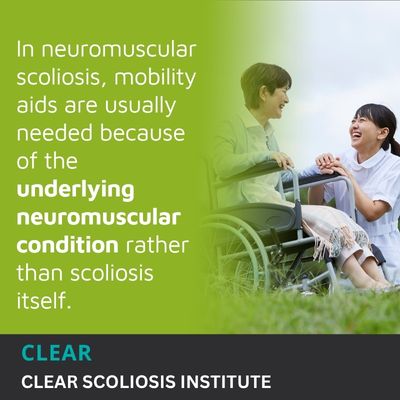 Although some neuromuscular scoliosis patients may require mobility aids such as walkers or wheelchairs, the larger neuromuscular/muscular condition causing the scoliosis is the driving force, so the connection to scoliosis is more indirect than direct.
Degenerative scoliosis affects older adults and is caused by the spine's stability decreasing due to degenerative changes. Many degenerative changes take place slowly over time, and disc degeneration is a main cause, but declining posture, bone health, and the cumulative effect of negative lifestyle factors may also contribute.
Instability, pain, and mobility changes, as stated, are common reasons for wheelchair use, and these are common effects of degenerative scoliosis, but in many cases, the symptoms are manageable without a wheelchair, and in some cases, can be improved with a personalized care plan.
Because degenerative scoliosis involves increasing instability, vulnerability to injury and fall prevention is also a concern, but because scoliosis is the primary cause, a proactive scoliosis treatment plan, in many cases, can improve the scoliosis and its effects.
Muscle strength and balance is a focus of targeted exercise and scoliosis-specific physical therapy, and increasing the spine's support may restore enough stability to preserve healthy movement and posture. A strong core is needed to support proper posture, and even incremental improvement to the spine's balance can make a huge impact on pain and stability for older patients.
Bracing may also provide additional support, stability, and short-term pain relief, and scoliosis-specific chiropractic care may be recommended in appropriate cases, to work towards increasing the spine's flexibility for further pain relief.
Treatment plans for degenerative scoliosis patients focus on pain management, postural correction, and core strengthening, and in most cases, when instability is a growing concern, fall prevention strategies and proactive treatment minimize the risks and support mobility.
While some older adult patients with severe curves experiencing extreme instability and pain may require a walker or wheelchair for temporary use or relief, it's rare for typical degenerative scoliosis patients undergoing treatment to be confined to a wheelchair full term.
Scoliosis curves that go untreated are likely to continue progressing, particularly if growth or spinal degeneration are occurring, and the best way to effectively manage symptoms is through a proactive care plan.
Untreated scoliosis can lead to complications in cases of severe and/or atypical curves. Further progression of severe untreated idiopathic curves may cause digestive issues and impact lung function, but reliance on a wheelchair isn't considered a common effect of untreated idiopathic scoliosis.
Untreated severe neuromuscular or degenerative curves are more likely to lead to reliance on a mobility aid because there are additional forces driving the scoliosis: neuromuscular/muscular disease and increasing degenerative instability.
Scoliosis causes the spine to curve unnaturally to the side and rotate, and while it can range in severity and its effects can be widespread, typical scoliosis curves undergoing treatment don't put patients in a wheelchair, and many cases are highly treatable. The types of scoliosis most closely associated with the use of mobility aids are neuromuscular scoliosis and severe degenerative scoliosis.
Typical cases of idiopathic scoliosis can be highly treatable, particularly with early detection and proactive treatment, and while mobility issues can occur, many of the unique challenges can be managed effectively with treatment.
Here at the CLEAR Scoliosis Institute, we don't just want to improve a patient's current spinal health; we want to preserve the spine's long-term health and function because a healthy spine supports a patient's overall health.
A timely spine assessment by a CLEAR-certified scoliosis chiropractor considers the many factors that contribute to scoliosis curve progression, and the goal of a proactive treatment plan is preventing progression, increasing symptoms, and the risk of complications such as reliance on mobility aids.
CLEAR provides a unique and innovative way of understanding scoliosis. Sign up to receive facts and information you won’t find anywhere else.